

 Back To Blog
 Do You Need Architect Drawings for Planning Permission

When you first decide to improve your home, the path to getting planning permission can seem complex. It is natural to think about the process, the rules, and the potential costs. This leads to the most common question we hear: "Do you need architect drawings for planning permission?"
It is a sensible question, and the simple answer is no. You do not legally need a chartered architect just to submit a planning application. However, your local planning authority does require a full set of professional drawings.
This guide will explain who can (and cannot) create these vital drawings or plans for you. We will also cover what drawings you actually need for a successful application.
Who Can Create Your Planning Drawings
When the council requests professional plans, you have several options. It is essential to consider who can produce your drawings for planning permission and the advantages and disadvantages of each.
Can I Do My Own Drawings For Planning Permission
Technically, yes. The planning portal allows anyone to submit drawings, as long as they meet the required standards.
However, this is extremely risky. Planning application drawings must be precise. They need to be drawn to a recognised scale (like 1:100 or 1:50) and include specific details, from your property boundary to roof heights.
Most DIY drawings fail at the first hurdle: validation. If your plans are not technically correct, the local planning authority will reject them outright. This can stop your project for weeks or months before it even begins.

What About a Draftsman or Architectural Technician
A draftsman or architectural technician is a specialist in producing technical drawings. They are often a more affordable option than a chartered architect for creating your drawings for planning permission.
They are very good at creating the elevations and floor plans your council needs. This can be a good choice. However, their service may only cover the drawings themselves. You might still be responsible for managing the full planning application and handling any revisions.
The Role of a Chartered Architect
A chartered architect is a highly qualified design professional. They can provide fantastic creative designs, not just the basic plans. They will manage the entire planning submission and use their experience to navigate complex issues.
This is a great, robust solution. The main drawback for many people is that this level of service can be expensive. You will also be hiring them for the design phase, but you will still need to hire a separate building company for the construction. This means managing two different contracts and relationships.
The Simple Solution - The Design and Build Advantage
There is a fourth option that solves these problems. A design and build company gives you a single, unified team for your entire project, from the first sketch to the final build.
At Linx, our in-house design team handles everything. We create all the professional drawings for planning permission that your council requires. Because our designers work alongside our builders, the plans we create are not just beautiful; they are practical, efficient, and designed to be built on budget.
This approach removes the stress from the process. You get one single point of contact. We manage the entire planning application for you and handle all communication with the local planning authority. There is no gap between the architect and the builder. It is one seamless, accountable service. This is the modern, simpler way to bring your project to life.
What Drawings Do You Actually Need
Now that you know who can create your plans, what do they actually need to draw? Your local planning authority will not accept just one drawing. They require a full set of plans to assess your project. Each plan has a specific job.
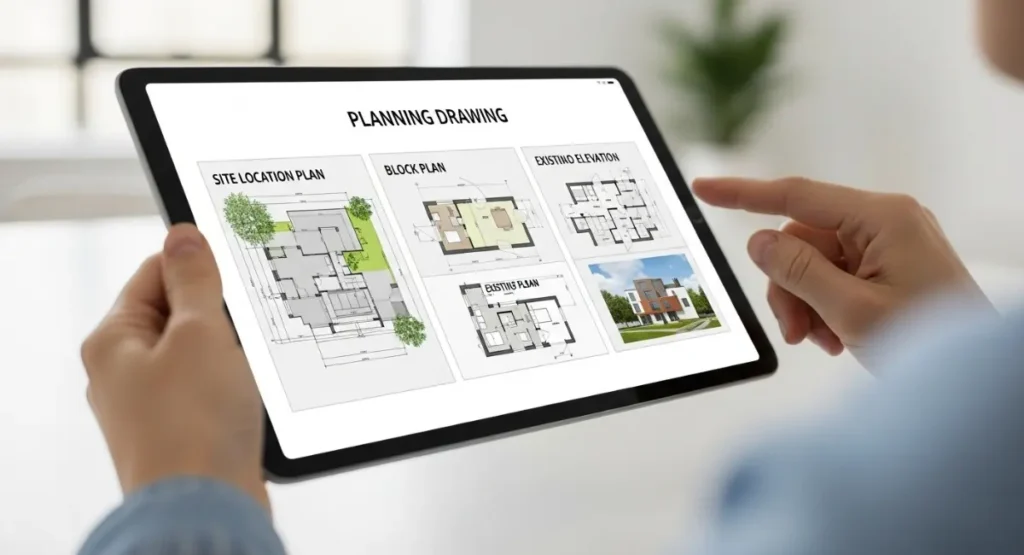
Site Location Plan
This is the "big picture" map. It shows your property in relation to the surrounding streets and houses. It is typically drawn at a 1:1250 scale and must be based on an Ordnance Survey map. It clearly outlines your property boundary with a red line.
Block Plan
The block plan (or site plan) is a more detailed, "top-down" view of your property. Usually at a 1:200 or 1:500 scale, it shows the property boundaries, the existing house, and the exact outline of the proposed new work. It also shows access points and any nearby trees.
Existing Plans and Elevations
This is the "before" set of drawings. They show the building exactly as it is today.
- Existing Floor Plans: A bird's-eye view of each floor's current layout.
- Existing Elevations: A "face-on" view of each side of your house (front, rear, and sides).
Proposed Plans and Elevations
This is the most important part of your drawings for planning permission. This "after" set clearly shows the council what you want to build.
- Proposed Floor Plans: Show the new layout, including any new rooms or walls.
- Proposed Elevations: Show how the house will look from the outside after the work is complete.
Section and Roof Plans
A section drawing is a "cut-through" view. It shows the internal changes, new ceiling heights, and floor levels. A roof plan is also vital, especially for a loft conversion, as it shows the shape of the new roof and the position of any rooflights.
Do You Need Drawings for Permitted Development
This is a very common point of confusion. Many homeowners assume that if their project falls under Permitted Development (PD), they do not need any drawings at all.
This is a risky mistake. While you may not need a full planning application, you absolutely need proof that your project is legal. The only way to get this proof is by applying for a Lawful Development Certificate (LDC).
To apply for an LDC, your local planning authority still requires a full set of professional-standard drawings. These are essentially the same drawings for planning permission that we have discussed. You will still need to provide scaled floor plans, elevations, and block plans.
Without an LDC, you may have serious problems when you try to sell your home. A design and build team can identify if your project is a permitted development and secure this vital certificate for you.
Conclusion
So, do you need architect drawings for planning permission? While you do not legally need a chartered architect, you absolutely do need a full set of professional, technically accurate plans. These drawings are the most critical part of your application.
Getting your drawings for planning permission right from the start is the key to avoiding costly delays and council rejections. It is the foundation of a smooth and successful project.
Ready to get your project started without the stress? Contact our expert design and build team today for a free consultation.
Frequently Asked Questions (FAQs)
What drawings are required for a planning application?
You typically need a full set of scaled plans. This includes a site location plan, a block plan, and sets of "existing" and "proposed" floor plans and elevations.
Can I submit my own drawings for planning permission?
Yes, you can, but it is very risky. Your plans must meet strict professional standards for scale and accuracy. If they do not, the council will not validate your application.
Do you need structural drawings for planning permission?
No, not usually. Structural plans (from a structural engineer) are for the Building Regulations stage. This comes after you have received planning permission.
What is a block plan for a planning application?
A block plan is a "top-down" view of your property. It clearly shows your property boundaries, the existing house, and the outline of the proposed work.
Back To Blog